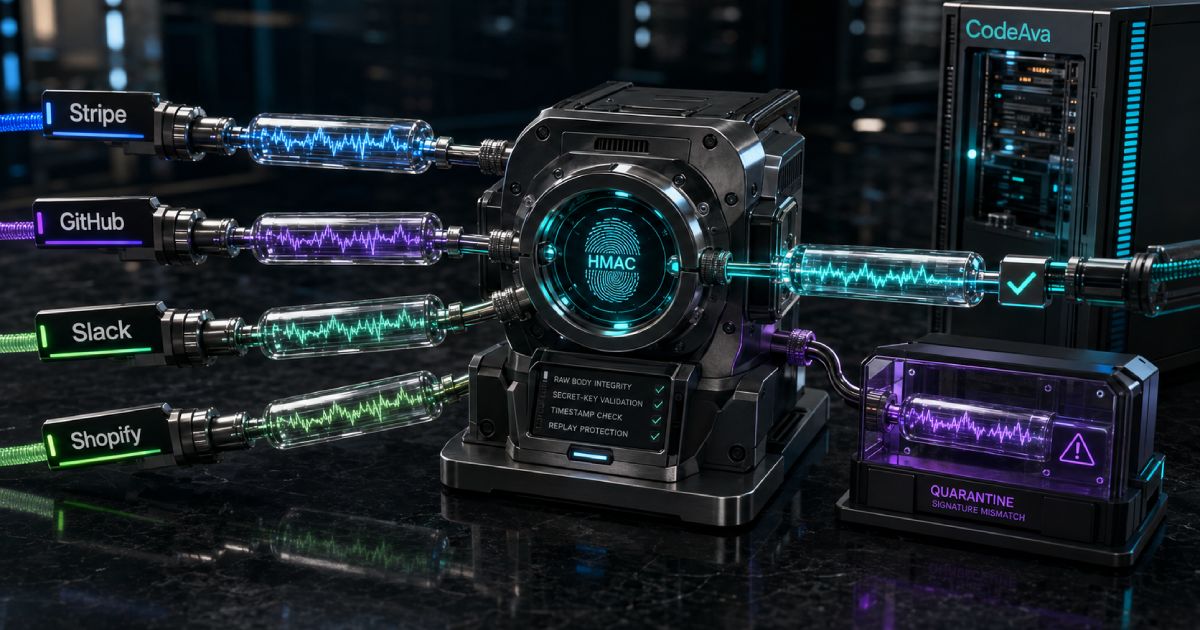

It is 3:00 AM and an API gateway begins returning 401 Unauthorized for valid users. No application release went out. The database is healthy. Okta, Auth0, Amazon Cognito, or another identity provider reports no incident. The authentication logs contain one clue: kid not found, no matching signing key, or JWKSNoMatchingKey.
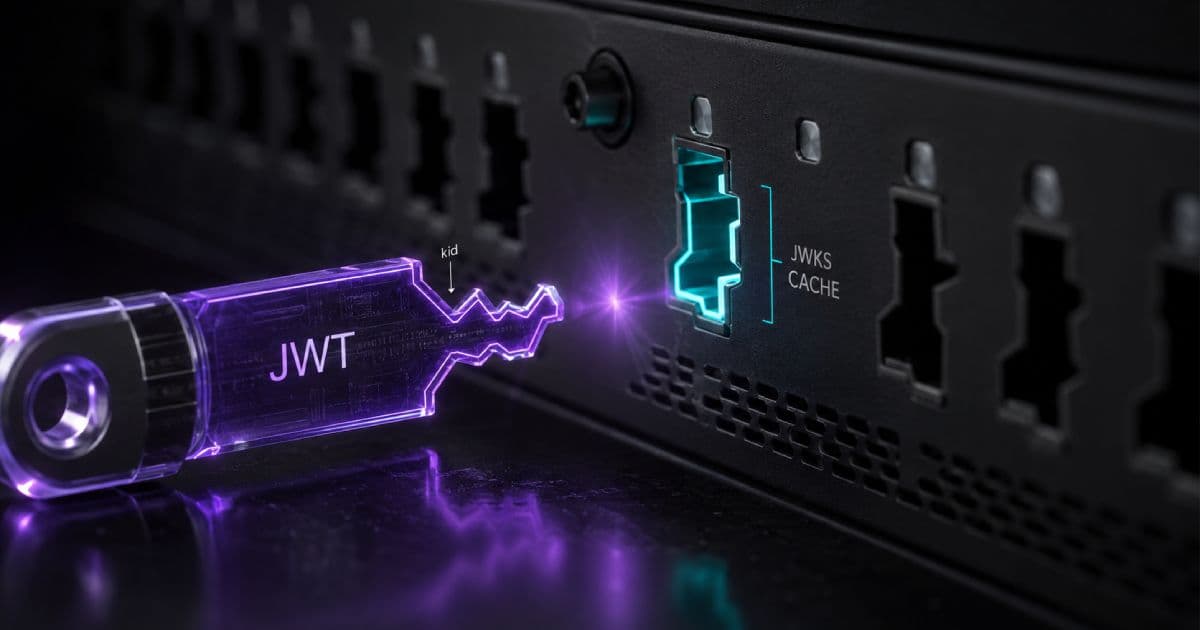
A signing-key rotation may have exposed a stale JWKS cache. The identity provider has started signing tokens with a new private key and published the matching public key, but your resource server still knows only the old key ID. It cannot select a verification key, so the request fails before the signature can even be checked.
Rotation is not the only explanation, however. The same error appears when a production token reaches a staging verifier, the API uses the wrong tenant's JWKS, the token's algorithm is incompatible with the matched key, or an attacker sends thousands of invented key IDs. Treat kid mismatch as a key-selection diagnosis, not a complete root cause.
TL;DR
- Read
alg,kid,iss, and other decoded values as untrusted debugging input until verification completes. - Select a preconfigured trusted issuer, discover or pin its
jwks_uri, and namespace the key cache by issuer. - Match
kidplus algorithm, key type, and signing use; never try every unrelated key or accept the token's algorithm without an allowlist. - Cache keys, but refresh once on an unknown
kidso a rotation can heal without fetching on every request. - Coalesce concurrent refreshes and rate-limit unknown-key fetches to prevent a random-
kiddenial-of-service attack. - After the signature passes, separately validate issuer, audience, time, token type, and application claims.
Inspect the failing token without treating decoded claims as trusted.
Use the CodeAva JWT Decoder to reveal the header, including alg and kid, and inspect iss, aud, exp, and nbf. Decoding helps you diagnose the token; it does not verify its signature or authorize a request.
What JWKS, JWK, and kid do in JWT verification
With an asymmetric signing algorithm such as RS256 or ES256, the authorization server holds a private key and uses it to sign a JSON Web Token. Resource servers do not receive that private key. They verify signatures with the corresponding public key.
A JSON Web Key, or JWK, represents a cryptographic key as JSON. A JSON Web Key Set, or JWKS, is an object containing a keys array. An OpenID Provider normally advertises the public set through the jwks_uri in its discovery metadata. The exact JWKS path is provider-specific; do not assume every issuer uses /.well-known/jwks.json without checking discovery or the provider documentation.
The protected JWT header commonly contains alg and kid. The key ID is a hint that lets the verifier choose one key from the set. It is not a password, a certificate fingerprint, or a globally unique identifier. Its meaning is scoped to the issuer's key set and configuration.
JWT protected header
{
  "alg": "RS256",
  "kid": "signing-key-2026-07",
  "typ": "JWT"
}

Trusted issuer metadata
{
  "issuer": "https://id.example.com/",
  "jwks_uri": "https://id.example.com/.well-known/jwks.json"
}

JWKS
{
  "keys": [
    { "kid": "signing-key-2026-06", "kty": "RSA", "use": "sig" },
    { "kid": "signing-key-2026-07", "kty": "RSA", "use": "sig" }
  ]
}
The verification flow
- The API determines which issuers are trusted from its own configuration or route—not from an arbitrary network location in the token.
- It reads the protected header to obtain the untrusted
kidandalgselection hints. - It looks for one compatible signing key in the trusted issuer's cached JWKS.
- If no key matches, it may refresh that trusted JWKS once and repeat selection.
- It verifies the cryptographic signature using an explicitly allowed algorithm.
- It validates claims such as
iss,aud,exp,nbf, token type, scopes, and tenant.
Why signing-key rotation can break a healthy API
Rotation limits how long one signing key remains active and provides a path to replace a compromised key. A well-coordinated rollover normally has an overlap period:
- The provider publishes a future public key in the JWKS.
- Verifiers refresh and learn both the old and new keys.
- The provider begins signing new tokens with the new private key.
- Both public keys remain available while previously issued tokens can still be valid.
- The old public key is retired after the provider's safe overlap period or immediately during an emergency response.
Outages occur when a component freezes the set at step one, removes the old key too soon, or keys its cache incorrectly. The first token signed with the new key reaches a server that has never seen that kid, and verification stops at key selection.
Rotation frequency is provider-specific
The distributed latency and rate-limit trap
Consider an identity provider in Virginia and APIs in London, Toronto, and Sydney. Calling the US-hosted JWKS endpoint for every token would add cross-region latency and make authentication depend on a remote service for every request. Caching is therefore an availability feature, not merely an optimization.
The opposite extreme is also dangerous. If every process caches a key forever, a normal rotation causes region-by-region failures. If every unknown kid forces a network fetch, an attacker can send tokens with random key IDs and turn the JWKS endpoint into a denial-of- service dependency. Five hundred concurrent misses can become five hundred outbound calls unless the client coalesces them.
A resilient design uses a warm cache for the normal path, a single-flight refresh for a legitimate miss, a cooldown or negative cache for repeated unknown IDs, and a bounded request rate. Each region should be able to observe and recover from rotation without creating a thundering herd.
Not every kid mismatch is a stale cache
| Observation | Likely cause | Next check |
|---|---|---|
| Live JWKS has the kid; API cache does not | Stale or broken refresh path | Cache age, TTL, refresh errors, and process version |
| Neither live nor cached JWKS has the kid | Wrong issuer or environment, retired key, forged token, or provider publishing problem | Trusted issuer, token age, provider status, and token source |
| kid matches, but selection still fails | alg, kty, use, key_ops, or curve mismatch | Allowed algorithms and JWK compatibility fields |
| Signature passes; request still returns 401 | Issuer, audience, expiry, not-before, token-use, or authorization failure | Exact validation error and expected claim configuration |
| Many unique unknown kids appear suddenly | Random-kid abuse or noisy invalid traffic | Refresh rate, source patterns, cooldown, and edge rate limits |
Incident playbook: diagnose a sudden 401 safely
1. Preserve the exact verifier error
“JWT invalid” hides the distinction between no matching key, a bad signature, and a claim failure. Capture the library error code, expected issuer, selected JWKS source, cache age, and request region. Do not log the bearer token or full claims.
2. Decode the token without trusting it
Extract the protected header and payload to inspect kid, alg, typ, iss, aud, iat, nbf, and exp. These values are readable because JWT encoding is not encryption. An attacker can create arbitrary header and payload JSON, so do not use the decoded issuer to fetch an unrestricted URL or grant access.
3. Determine the expected issuer from trusted configuration
For a single-issuer API, the expected issuer should be explicit. For a multi-tenant API, map the untrusted issuer hint only to a closed allowlist of pre-approved tenant configurations. Confirm details that are easy to confuse: custom domain versus provider domain, trailing slash, region, authorization server ID, user pool ID, and staging versus production.
4. Resolve the JWKS through trusted discovery
Retrieve the expected issuer's OpenID configuration and confirm its returned issuer exactly matches the configured issuer. Use its jwks_uri or a provider-documented pinned URI. Never follow an arbitrary jku or x5u supplied by the token unless an explicit security profile constrains it to trusted locations.
# Inspect public metadata; do not paste the bearer token into shell history.
curl -fsS https://id.example.com/.well-known/openid-configuration | jq '{issuer, jwks_uri}'

# Fetch the trusted URI returned by discovery.
curl -fsS https://id.example.com/.well-known/jwks.json | jq '.keys[] | {kid, kty, alg, use, key_ops, crv}'
5. Compare key compatibility, not kid alone
A matching string is only the first filter. The key must support the allowlisted JWT algorithm and key family. If present, useshould permit signatures and key_ops should permit verification. RSA, elliptic-curve, and EdDSA keys are not interchangeable. A robust JOSE library performs these checks; custom code often does not.
6. Refresh once, then classify the result
If the trusted live JWKS contains the new kid, force or await the library's guarded refresh and retry selection exactly once. If the key is still absent, fail closed. Repeatedly fetching until the token succeeds will not repair a wrong issuer and gives attackers an outbound-request primitive.
Build a resilient JWKS cache
Use provider guidance instead of one universal TTL
The draft recommendation to cache every JWKS for 10–24 hours is too broad. Okta, for example, tells clients to follow the standard HTTP Cache-Control directives returned by its JWKS endpoint. Other libraries use an internal TTL; current jwks-rsa and jose documentation describe a ten-minute default cache age. Amazon Cognito recommends periodic refresh and a refresh when a token from the correct issuer arrives with a different kid.
Choose a policy that matches the provider and test it. A shorter TTL discovers planned rotations and revocations sooner but increases remote dependency and request volume. A longer TTL improves independence during outages but delays change detection. Conditional requests with ETag or Last-Modified can reduce payload cost when the endpoint supports them.
Refresh synchronously on a legitimate cache miss
A background refresh alone does not help the first valid request: that request still receives a 401. For a token mapped to an allowed issuer, an unknown kid should normally wait for one bounded refresh, retry key selection once, and then succeed or fail. Keep the timeout short enough that authentication cannot hang indefinitely.
Coalesce refreshes and suppress repeated misses
Use a mutex, promise single-flight, or equivalent mechanism per issuer so concurrent requests share one in-progress fetch. Add a cooldown after a successful fetch, and briefly negative-cache unknown key IDs so the same forged value cannot trigger another request immediately. Bound the number of issuers, keys, response bytes, redirects, and outbound request time.
Keep old keys during the token-validity overlap
A refresh should replace the cache with the provider's authoritative current set, not discard a still-published old key simply because a new one appears. Providers often publish more than one valid signing key so tokens minted before rotation can remain verifiable until they expire. Do not assume the newest key is the only acceptable key.
Decide explicitly whether to serve a stale known key
Some clients can continue using a previously cached key when the JWKS endpoint is temporarily unreachable. That can keep already-known tokens working, but it is an availability-versus-security decision: a stale cache may continue trusting a key the provider intended to revoke. A stale known key cannot validate a token signed with an unseen new key. Set a bounded fallback window, alert whenever it is used, and align it with your incident-response policy.
Node.js example with jwks-rsa
jwks-rsacaches signing keys and can rate-limit JWKS requests caused by cache misses. The example pins the issuer, audience, algorithm, JWKS URI, cache size, cache age, request timeout, and request rate. Replace the placeholder values with one trusted environment's configuration.
import jwt, { type JwtHeader, type SigningKeyCallback } from "jsonwebtoken";
import jwksRsa from "jwks-rsa";

const ISSUER = "https://id.example.com/";
const AUDIENCE = "https://api.example.com";

const client = jwksRsa({
  jwksUri: "https://id.example.com/.well-known/jwks.json",
  cache: true,
  cacheMaxEntries: 5,
  cacheMaxAge: 10 * 60 * 1000,
  rateLimit: true,
  jwksRequestsPerMinute: 10,
  timeout: 5_000,
});

function getSigningKey(header: JwtHeader, callback: SigningKeyCallback) {
  if (header.alg !== "RS256" || !header.kid) {
    callback(new Error("Missing kid or disallowed JWT algorithm"));
    return;
  }

  client.getSigningKey(header.kid)
    .then((key) => callback(null, key.getPublicKey()))
    .catch((error: Error) => callback(error));
}

export function verifyAccessToken(token: string) {
  return new Promise((resolve, reject) => {
    jwt.verify(
      token,
      getSigningKey,
      {
        algorithms: ["RS256"],
        issuer: ISSUER,
        audience: AUDIENCE,
        clockTolerance: 5,
      },
      (error, payload) => {
        if (error) reject(error);
        else resolve(payload);
      },
    );
  });
}
The library's rate limit protects the upstream JWKS endpoint from random kid values, but it is not a complete API rate limiter. Apply normal request controls at the gateway as well. In a large fleet, every process may still have its own allowance; pre-warming or a carefully designed shared cache can reduce regional bursts.
Recent jwks-rsa versions also offer a bounded stale-key fallback for JWKS endpoint outages. Use it only after evaluating the revocation tradeoff, and emit a high-signal metric whenever a stale key verifies a token.
Modern Node.js example with jose
The jose remote JWKS resolver fetches when no key matches, applies a cooldown to prevent repeated network requests, and selects keys using algorithm, key type, kid, use, and key_ops where present. jwtVerify also validates registered claims supplied in its options.
import { createRemoteJWKSet, jwtVerify } from "jose";

const ISSUER = "https://id.example.com/";
const AUDIENCE = "https://api.example.com";
const JWKS = createRemoteJWKSet(
  new URL("https://id.example.com/.well-known/jwks.json"),
  {
    cacheMaxAge: 10 * 60 * 1000,
    cooldownDuration: 30 * 1000,
    timeoutDuration: 5 * 1000,
  },
);

export async function verifyAccessToken(token: string) {
  const { payload, protectedHeader } = await jwtVerify(token, JWKS, {
    algorithms: ["RS256"],
    issuer: ISSUER,
    audience: AUDIENCE,
    clockTolerance: 5,
    requiredClaims: ["sub", "iat"],
  });

  return { payload, protectedHeader };
}
Prefer the provider's supported verifier
aws-jwt-verify library and distinguishes ID-token aud from access-token client_id and token_use checks.Security mistakes that turn refresh logic into a vulnerability
Trusting jku, x5u, or iss as an arbitrary fetch target
Before verification, every token field is controlled by the sender. Blindly fetching a token-supplied URL can expose internal metadata services, localhost, private networks, or attacker-hosted keys. Resolve only preconfigured HTTPS issuers and JWKS locations, validate discovery metadata, restrict redirects, and apply outbound network controls.
Accepting whatever alg the token requests
The token's alg header describes what its creator wants the verifier to use; it does not grant permission. Pin the algorithms expected for that issuer and token type. Never let an RS256 integration fall back to HS256 with public-key bytes as a shared secret, and reject none unless a separate, explicit profile requires an unsecured JWT.
Caching by kid alone
A key ID can repeat across tenants, providers, or environments. A global map such as cache[kid] can select a key from the wrong trust domain. Scope entries by trusted issuer or JWKS source, key ID, algorithm family, and any provider-specific tenant boundary.
Trying every key when kid is unknown
Blindly iterating through unrelated keys hides configuration mistakes, increases CPU cost, and can create key-confusion behavior. Follow the protocol and library's documented selection rules. If a profile allows tokens without kid, require that exactly one compatible key matches or use a library that handles ambiguity safely.
Stopping after signature verification
A valid signature proves only that a trusted key signed the protected header and payload. It does not prove that the token was issued for this API or can perform this action. Validate iss, aud, exp, nbf, and token-profile fields; then apply scopes, roles, tenant, subject, and resource-level authorization. See the guide to JWT expiry and clock-skew debugging for time-related failures that can resemble a signature incident.
Observability for a self-healing verifier
Authentication failures should be diagnosable without exposing bearer tokens or personal data. Record structured, bounded fields such as:
- trusted issuer configuration ID and deployment environment;
kid, algorithm, and verifier error category without the raw token;- cache hit, miss, age, entry count, and refresh reason;
- JWKS response status, latency, timeout, and last successful fetch;
- single-flight waiters and requests suppressed by cooldown;
- stale-key fallback use and remaining fallback window;
- region, service version, and identity-provider tenant;
- separate counts for key selection, signature, issuer, audience, time, and authorization failures.
Alert on a rapid increase in one unknown kid across several regions because it may indicate a rotation. A high-cardinality flood of random IDs is more consistent with abusive traffic. Bound metric labels or hash unknown IDs to prevent telemetry-cardinality attacks.
Test rotation before the identity provider does it for you
A unit test with one static key does not exercise the failure mode. Build an integration fixture that can publish two JWKS versions and sign tokens with both keys:
- Warm the verifier with key A and validate an A-signed token.
- Publish A and B, then send a B-signed token.
- Confirm one guarded fetch occurs and all concurrent B requests share it.
- Confirm A-signed tokens remain valid while A is still published and unexpired.
- Remove A and verify behavior after cache expiry matches your provider and revocation policy.
- Send hundreds of random kids and confirm the endpoint rate limit, cooldown, and negative cache protect the JWKS service.
- Simulate DNS failure, timeout, malformed JSON, oversized JWKS, duplicate matches, and a JWKS endpoint outage.
- Verify wrong issuer, audience, algorithm, token type, and environment are rejected even when a cryptographic key could verify the signature.
Inspect a token and JWKS safely with CodeAva
The fastest manual comparison is to decode the JWT header, copy the kid, and list the keys returned by the expected issuer's live JWKS. The CodeAva JWK/JWKS Inspector & JWT Signature Debugger combines those steps: it matches kid, checks algorithm compatibility, verifies supported signatures with Web Crypto, and separates cryptographic failures from claim diagnostics.
JWT parsing and signature operations in the tool run locally in the browser; the JWT itself is not sent to CodeAva. When you ask the tool to fetch a remote JWKS URL, a server-side fetch layer is used for CORS reliability, so use only public endpoints you are authorized to inspect. Prefer a short-lived test token with synthetic claims and never paste a production HMAC secret.
Production checklist
- Configure an exact issuer, audience, token type, and algorithm allowlist for every accepted JWT profile.
- Resolve
jwks_urifrom validated discovery metadata or a trusted pinned configuration. - Namespace caches by issuer or tenant plus
kid; never bykidalone. - Cache compatible signing keys according to provider guidance and refresh them periodically.
- On an unknown
kid, perform one bounded, synchronous refresh and one selection retry. - Coalesce concurrent refreshes, apply a cooldown or negative cache, and rate-limit outbound JWKS requests.
- Set connect and response timeouts; bound redirects, response size, number of keys, and accepted key types.
- Keep overlapping old and new keys while the provider publishes them; do not assume one-key JWKS documents.
- Decide and document the stale-key availability versus revocation tradeoff.
- Validate signature and claims in one maintained JOSE or provider-specific library, then apply application authorization.
- Never fetch arbitrary token-supplied URLs or hardcode a rotating public key in the repository.
- Monitor cache misses, refresh failures, unknown-kid patterns, stale fallback, and claim failures without logging bearer tokens.
- Exercise planned rotation, emergency removal, concurrency, and JWKS outage paths in tests.
Trust the configured issuer, not the token's suggestion. Cache its published keys, but keep the cache capable of revalidating itself. A verifier that refreshes once on a legitimate miss, suppresses abusive misses, and still validates every claim can absorb normal signing-key rotation without turning authentication into a 3:00 AM outage.